Georgia: The Country That Taught Me What Wine Is Actually For
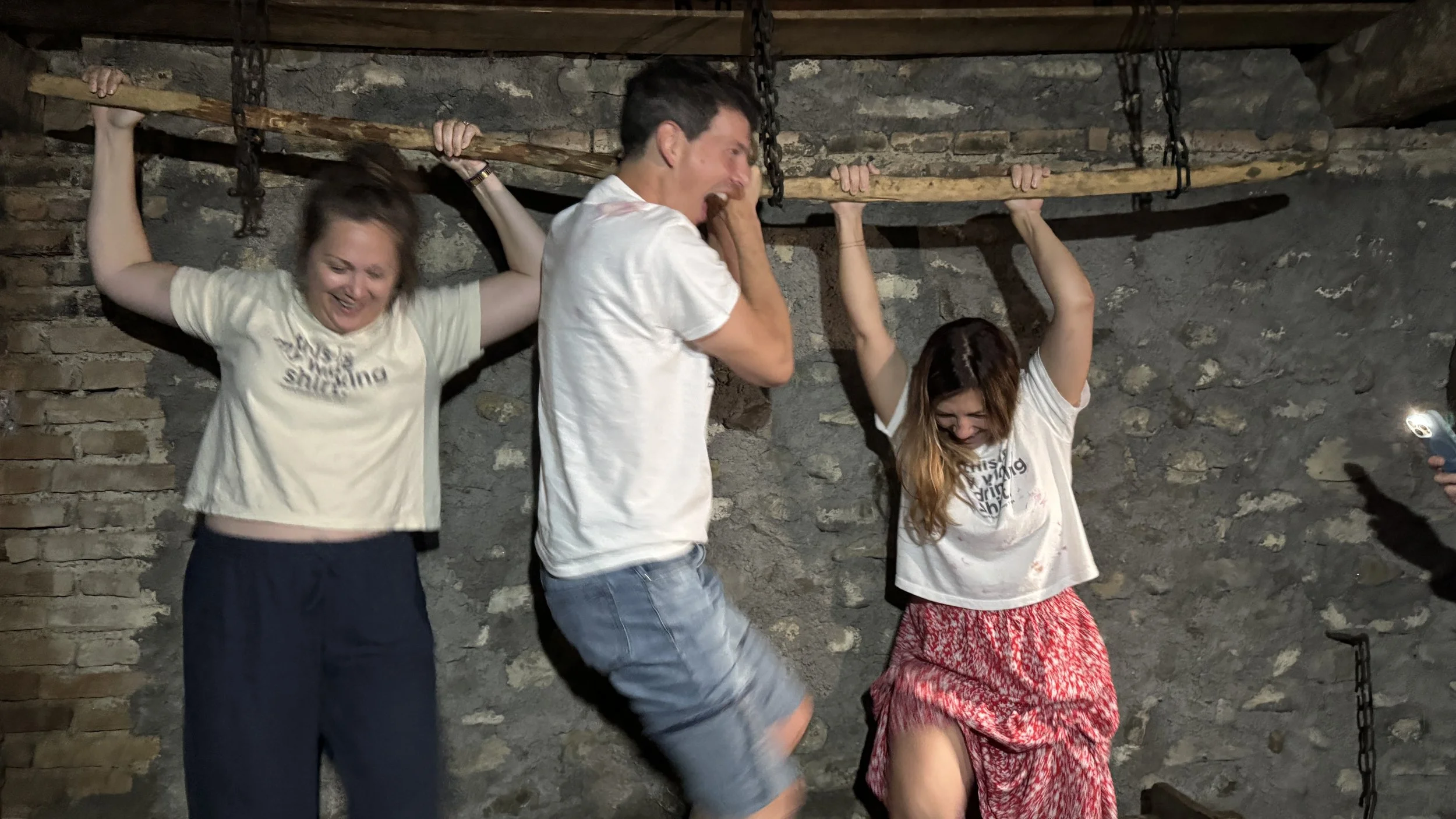
Crushing grapes with our feet in Georgia, a real-life I Love Lucy moment
Last fall, in a farmhouse courtyard in Kakheti, I watched one of my travelers shotgun wine out of a clay roof tile while a Georgian family cheered her on like she'd just stuck an Olympic ski landing.
Welcome to Georgian wine culture.
Nobody was drunk. Okay, nobody was that drunk. But you have to understand something about Georgia: wine isn’t something you order. It’s something you’re handed, poured, toasted with, refilled a million times, and apparently, something that’s launched down a roof tile into a grown adult’s mouth like it’s totally and completely normal.
Ever since I first visited Georgia in 2024–and went back with my first group in October 2025—I’ve been trying to explain Georgia to people who haven’t been.
Georgia isn’t the kind of place that people dream about visiting. When I tell people that I’m heading to Georgia, they usually say to me, “Yeah, I’ve been to Atlanta too. It’s not that great.”
So, I wanted to take a moment to try and successfully describe it in this blog. Consider this my best attempt. I'd recommend pouring yourself something first—and if you happen to own this exact shirt, now's the moment to put it on. I'll be enjoying a local Georgian Saperavi with you as I write.
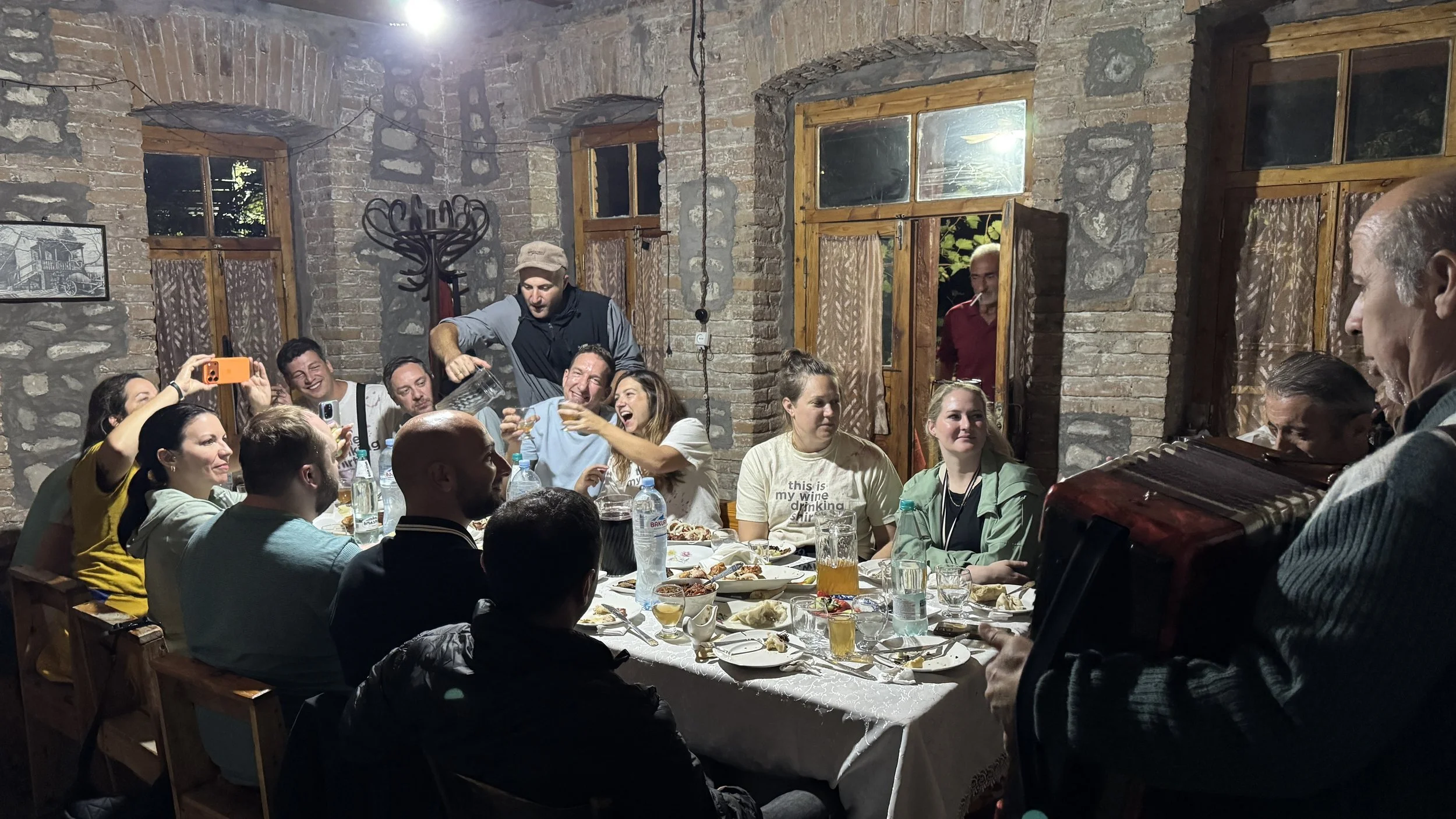
Our group in the throws of a traditional Georgian supra
Why is Georgia called the birthplace of wine?
Because it literally is. Georgia sits in the Caucasus—a highly diverse and mountainous region between the Black and Caspian seas that serves as the dividing line between Europe and Asia. Archaeologists have traced winemaking there back 8,000 years, which is the oldest evidence of wine anywhere on Earth.
For perspective: France has been making wine for roughly 2,500 years. Georgia had about a 5,000-year head start and has spent it accumulating more than 500 native grape varieties with names like Saperavi and Rkatsiteli (which you will absolutely butcher and they will absolutely forgive you for).
Here’s the cool part: While so much of modern winemaking is about combining ancient tradition with technology to do things like control temperature and optimize grape quality, Georgians still make wine the way they did thousands of years ago—in qvevri, giant egg-shaped clay vessels lined with beeswax and buried up to the neck in the earth.
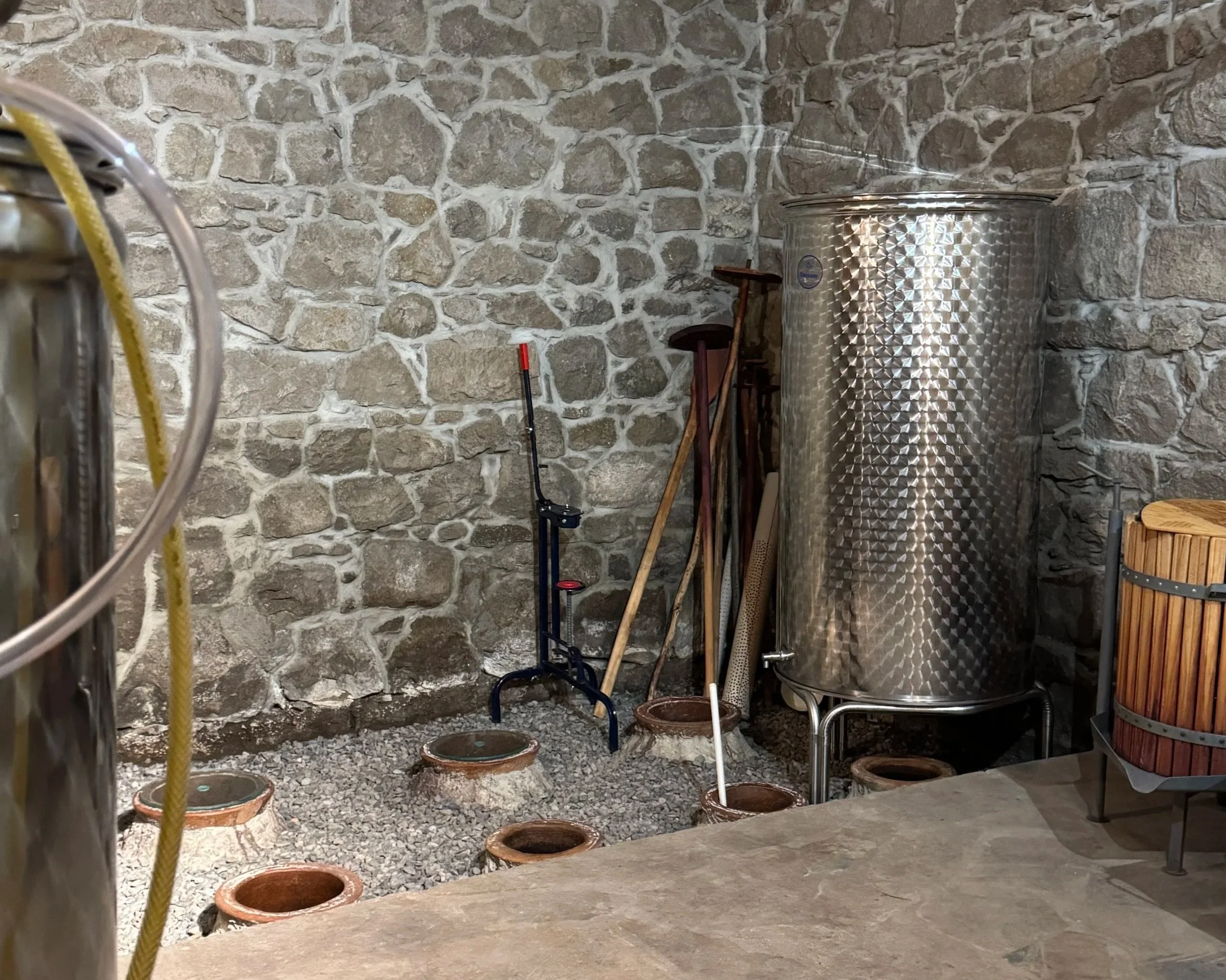
Qvevris buried in the ground of a home wine cellar
Grapes go in whole: skins, stems, seeds, everything. The earth keeps the temperature steady while the wine does its thing all winter. The method is so singular that UNESCO protects it, and it produces amber wine—white wine with the color of whiskey and a personality all its own. It’s wine that people fly across the world to taste at its source.
The wine isn’t locked away in some fancy tasting room. Wine in Georgia is a household chore, like mowing the lawn or shoveling the driveway is for us. Families have a marani—a home wine cellar—and then there’s grandpa’s qvevri out back. (This is how you end up in a stranger’s basement at 2 pm on a Tuesday, drinking wine his grandfather taught him to make, wondering if you really need to go back home or if you can just move in.)
Georgian Supra: Not a dinner so much as a ceremony
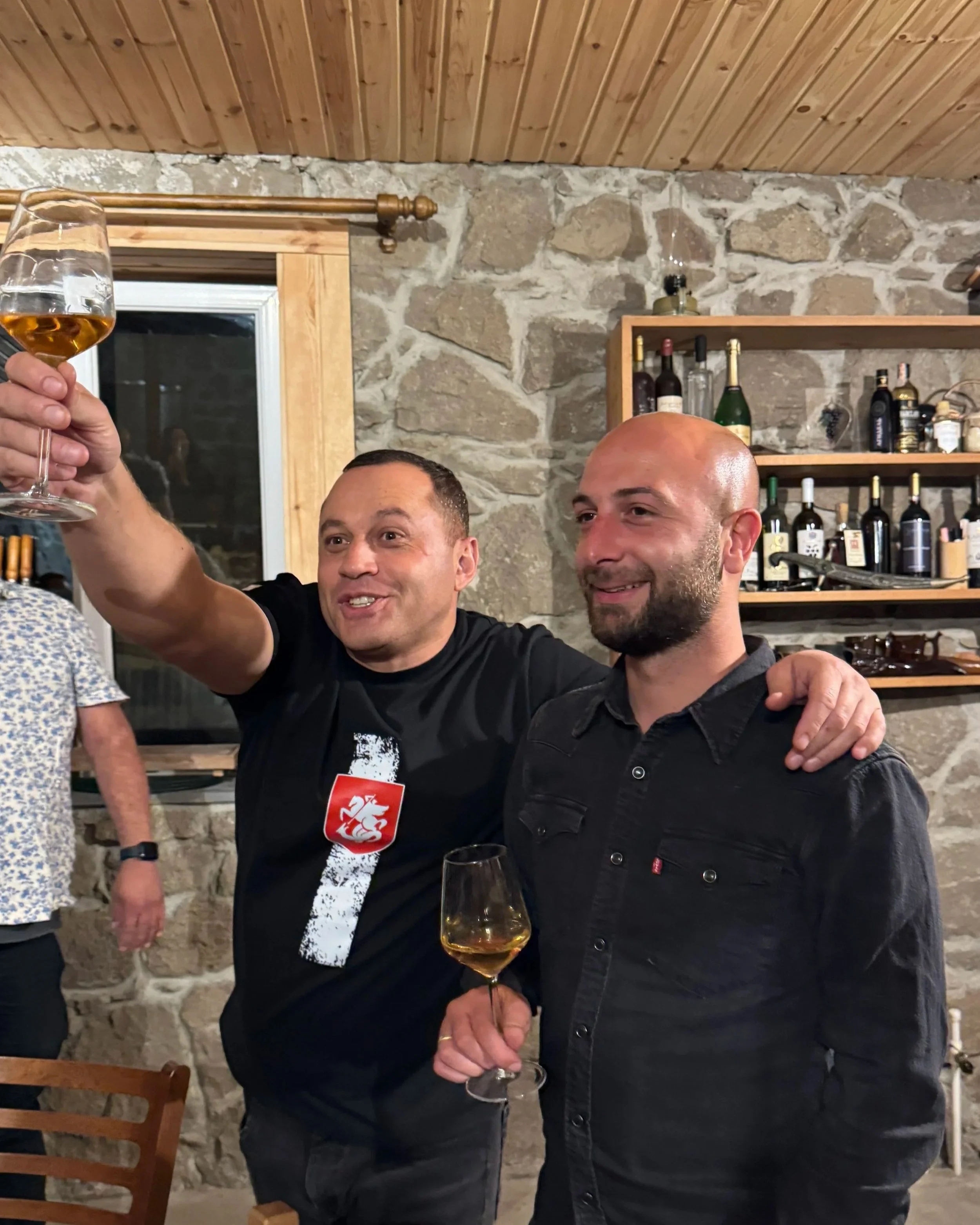
Our tamada and our guide, leading the supra
Every culture has a feast. Georgia has the supra, and the supra has rules.
There's a tamada (a toastmaster) whose entire job is to steer the evening through a series of toasts: to peace, to ancestors, to mothers, to friendship, and eventually to the guests (which is you, which is when you'll get unexpectedly misty over your khachapuri.)
Between toasts, the table groans under more food than the laws of physics should allow— cheese-filled bread (that’s the khachapuri), soup dumplings called khinkali, grilled meats, and walnut everything (an ingredient that’s the cornerstone of Georgian cuisine).
Mea, Melissa, and Erik, who came on the October 2025 Georgia trip, spent a solid stretch of their trip recap podcast episode just trying to describe the khachapuri situation. Erik used the phrase "cheese coma." He was not exaggerating.
Just when you think the dinner is winding down, someone starts singing. And it’s not a “Oh, someone’s singing along to a song on a Spotify playlist” kind of thing. It’s actual polyphonic singing, which UNESCO also protects, by the way.
Think we were done with wine? Nope. That keeps coming, too. There is no such thing as, “Oh, I’ll just have one glass.”
There's a Georgian saying that every guest is a gift from God, and they behave accordingly. The hospitality is so relentless it borders on a contact sport. And as you can see, we hated the hospitality.
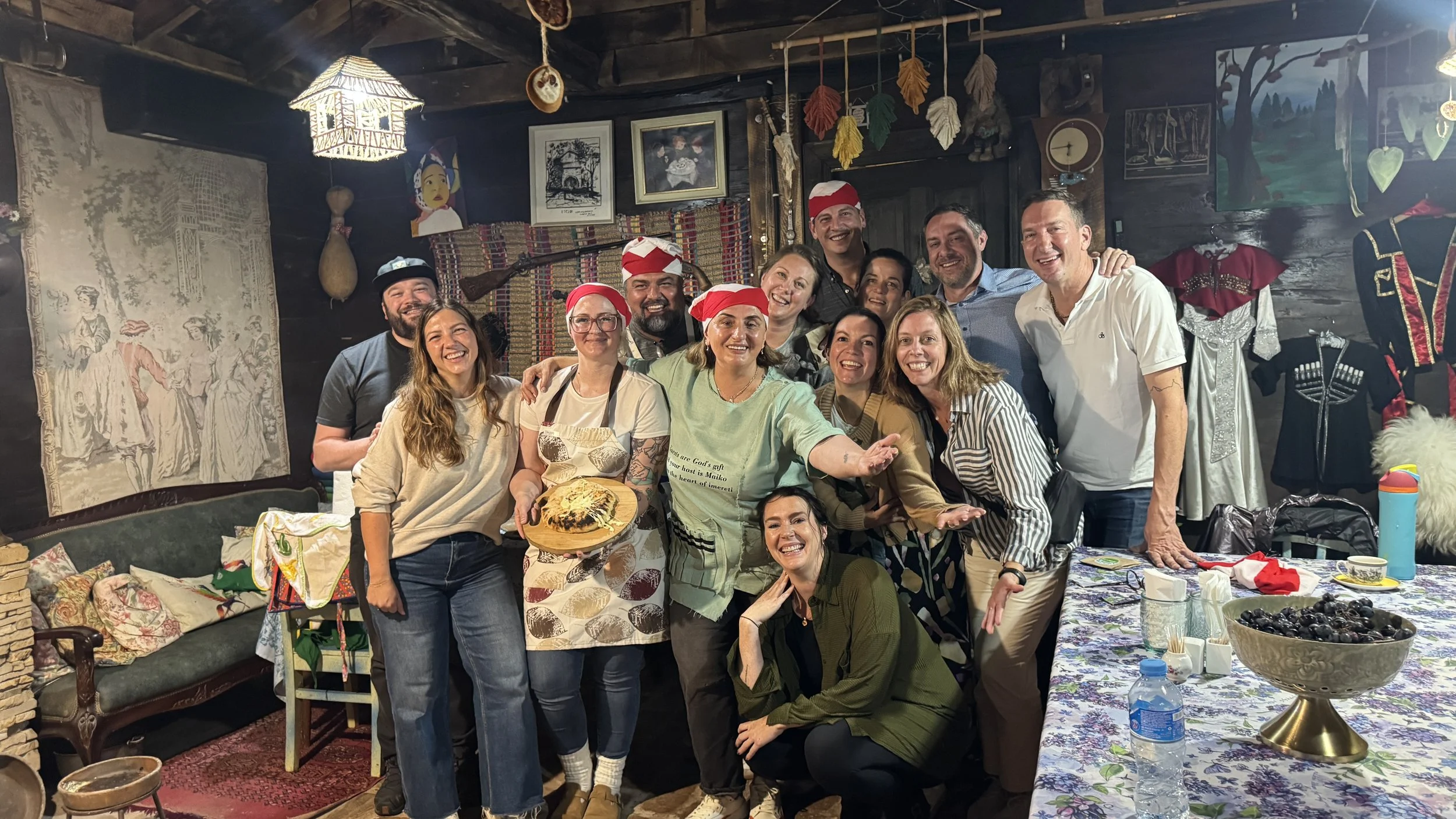
Making our own Georgian food in a local’s home
October: When Georgian wine culture goes full send
October in Georgia is harvest season—the rtveli—and the whole country shifts into celebration mode.
You know that I Love Lucy episode where she stomps grapes? Yeah, that actually happens, and it happens in Georgia. On our harvest day in Kakheti, we picked grapes with a family of winemakers, kicked off our shoes, and stomped them the way this exact valley has done it for a few thousand years—with live folk music, because it makes the grapes happy (and us too).
Then we learned to fold khinkali (harder than it looks), watched the family work their magic on the BBQ, and sat down to a harvest supra as the sun dropped behind the vineyard. Somewhere in there is where the roof-tile wine shotgun happened. I still don't fully understand the physics of it all. I just remember that everyone was laughing so hard we cried.
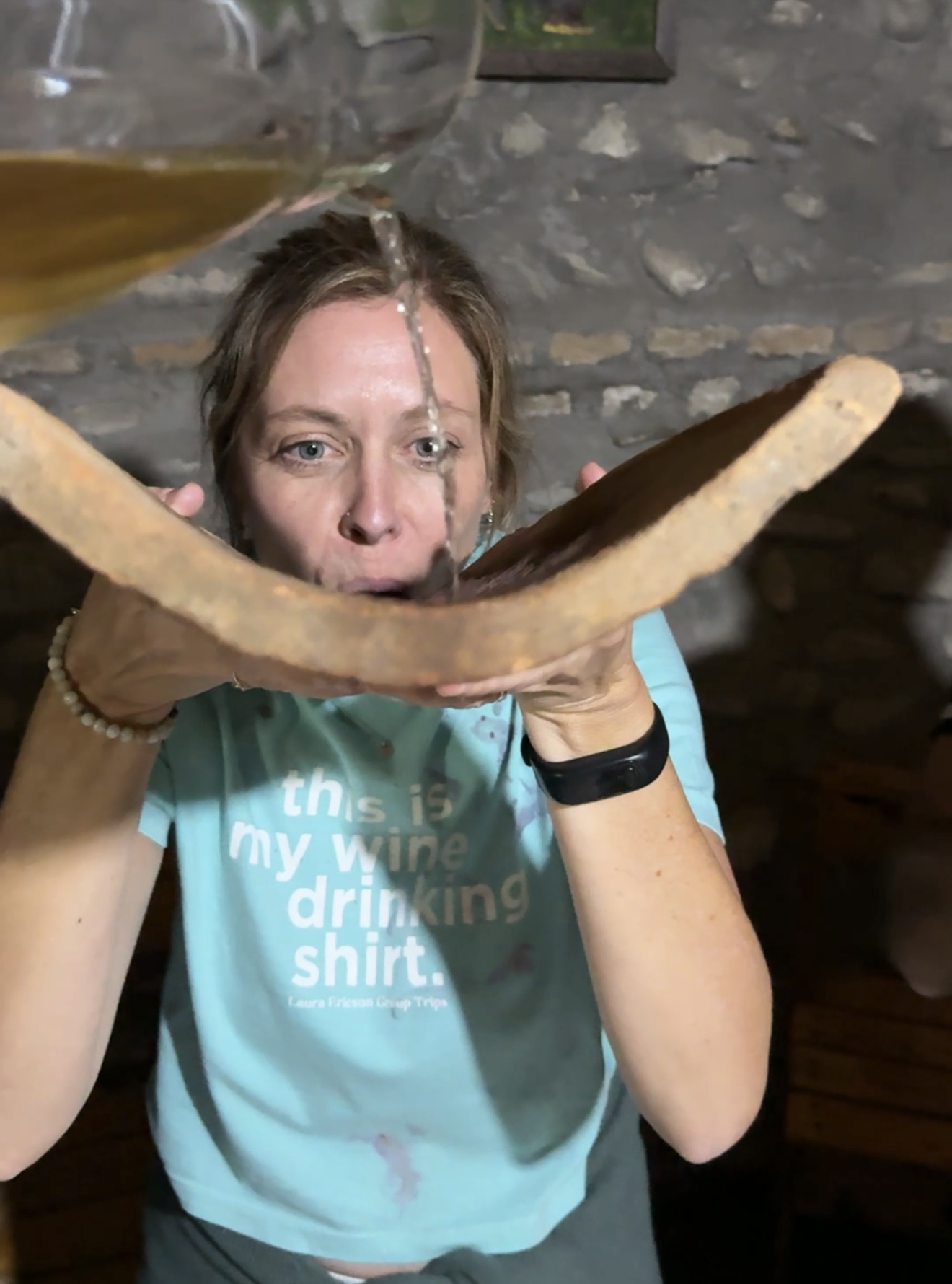
Katy, doing the honors of the Georgian roof tile wine shotgun
The part nobody puts in the brochure
Here's what actually made me want to write this post.
I've led 34 group trips at this point—over 400 travelers across 10 countries—and the Georgia group bonded harder and faster than any group I have ever taken anywhere. Some of that is chemistry, but I’m willing to bet that some of it was also the topless sulfur baths we did together on our first day in Tbilisi on day one (just like a Moroccan hammam, a Georgian sulfur bath will fast-forward a friendship in ways I can’t fully explain on a family-friendly blog.)
Most of it, I'm convinced, is Georgia itself.
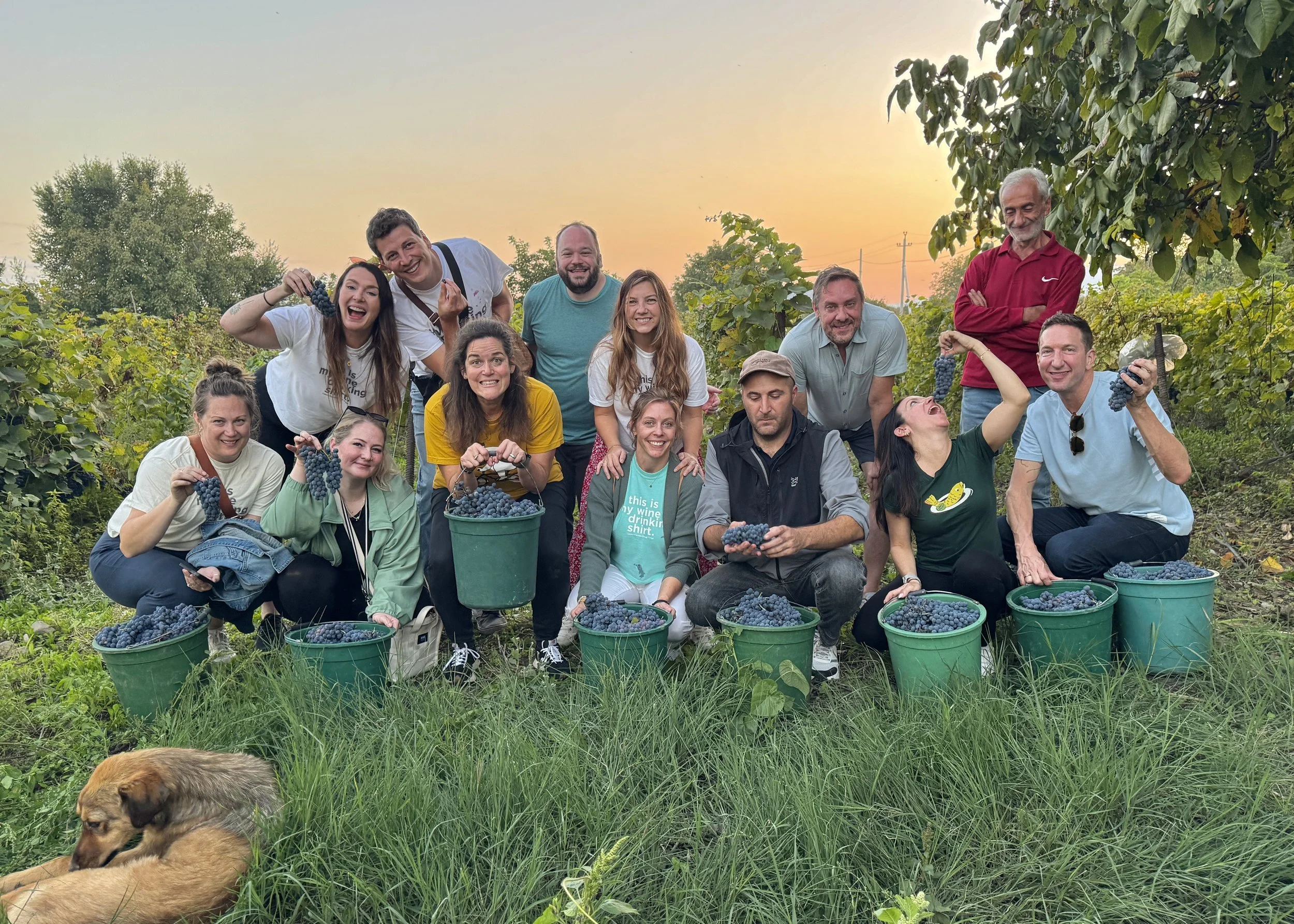
Harvesting our own grapes as part of the Rtveli
Here’s what 8,000 years of practice teaches a culture: wine was never the entire point. Wine is the excuse to keep you at the table. Every qvevri, every toast, every four-hour supra exists to do one thing: hold people together long enough for strangers to become something else. Georgians figured out the technology for human connection several millennia before the group chat, and it still works.
Here’s to a different kind of wine country
Maybe you've done Napa, you've done Tuscany, and they were lovely and also exactly what you expected. Maybe you keep saying "I want to go somewhere different" and then booking somewhere predictable and “safe.”
Hear me out: come to Georgia with us.
From October 2-11, 2026, I’m taking a dozen people back for the harvest. We'll stomp grapes in Kakheti, sweat it out in the sulfur baths, eat our way through supras in wine cellars with polyphonic singing at the table, and wander everywhere from Old Tbilisi to abandoned Soviet spa towns. And like all of our trips, we handle every detail.
All the details are on the Georgia trip page, but if you want to keep going down the Georgia rabbit hole, you can read about Erik's first-ever group trip (he was a group-travel skeptic—emphasis on “was”), or listen to the Georgia trip recap with Mea, Melissa, and Erik (the sulfur bath story alone is worth the download).
Listen to Episode 25: How Wine and Group Travel Built Community in Georgia →
If you’ve got more specific questions, I’m always just an email away—and will never turn down an excuse to talk about this country.