What Is Type 2 Fun? (And Why the Best Trips of My Life Were Miserable in the Middle)
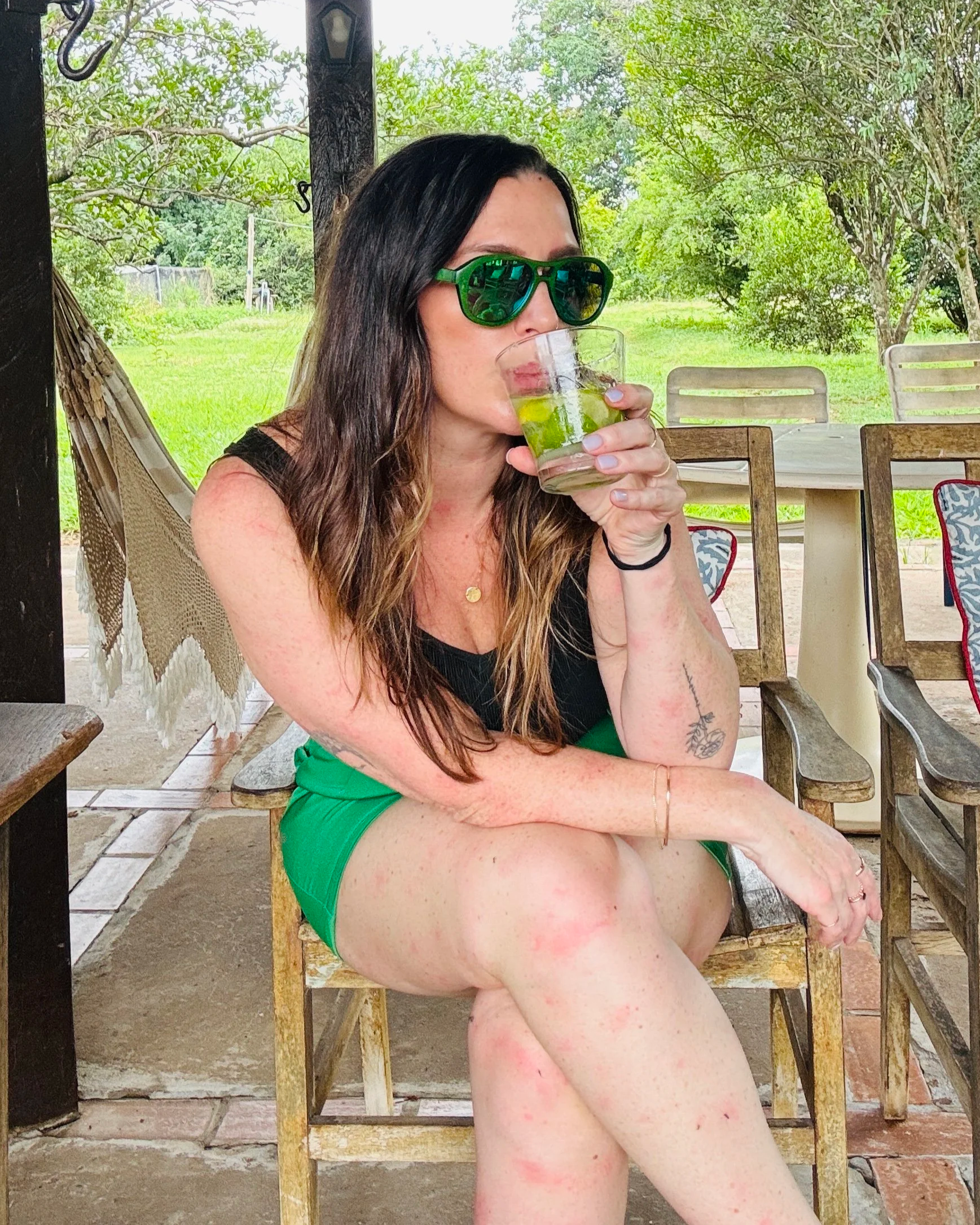
Sipping a caipirinha after a full-on mosquito attack, Pantanal Brazil
I once sprinted through O'Hare with forty pounds of Greek pottery on my back, mid-asthma attack, wheezing past gate B17 like a woman fleeing a crime scene.
And I’d just peed my pants.
Let me explain…
It was a nine-hour layover on my way home, and jet lag had absolutely flattened me — I passed out cold at my gate. Which, fine, no harm done: I'd been parked there for hours, boarding pass ready, nothing to worry about.
Except airlines love to move a gate the second you close your eyes. When I woke up, my flight wasn't just boarding, it was boarding at a completely different concourse.
So I ran. Forty pounds of ceramic on my back, no time for the pre-board bathroom stop, and — let's be real, I'm 43, IYKYK — somewhere in that dead sprint, I peed my pants. The math was simple: race through the airport like I was qualifying for something and lose a little dignity, or spend another twenty-four hours in O'Hare waiting on the next flight.
I chose the running. Obviously.
I definitely didn’t board my flight with my dignity intact. But somewhere between the gasping and the ceramic clanking, a thought floated through my oxygen-deprived brain:
This will be funny…someday.
At the time, it was the worst travel moment of my life. Today it's one of my favorite stories to tell — the kind that makes a whole dinner table lean in. That gap right there, between this is a disaster and this is the best story I own, has a name. It's called type 2 fun, and once you learn to spot it, you start planning your entire life around it.
What is Type 2 Fun?
Type 2 fun is any experience that's miserable while it's happening but deeply rewarding once it's over — the trips, climbs, and misadventures that feel awful in the moment and become legendary in the retelling. It's not fun now. It's fun later, in memory, forever. The suffering is the setup; the story is the payoff.
The term comes from climbers and mountaineers, who needed a way to describe why they'd voluntarily freeze on a rock face for twelve hours and then immediately book the next trip. They landed on something called the Fun Scale, and once you know all three types, you'll never look at a vacation the same way again.
The Fun Scale: Type 1, Type 2, and Type 3 Fun
Here's the whole map, and where I think most of life's best stuff actually lives.
Type 1 fun is fun while it's happening. A beach chair with a frozen drink in hand. A long lunch with wine. A perfect sunset with zero mosquitoes. It's lovely, it's easy, and — let's be real —predictable. You forget most of it by Tuesday, or it blends in with all your other “fun” memories. Type 1 fun is a vacation.
Type 2 fun is miserable while it's happening and glorious afterward. The 72-kilometer bike ride. The overnight bus. The safari truck buried to the axles in flood mud in the Maasai Mara while you wonder, briefly, if this is how it ends. You don't post about it in the moment. You become it in the retelling. Type 2 fun is a trip.
Type 3 fun is never fun. Not during, not after. It's the genuinely traumatic stuff you don't repeat and don't recommend. Getting demolished by mosquitoes in Brazil's Pantanal until I looked like a connect-the-dots puzzle flirted with Type 3, if I'm honest. The goal isn't to chase this one — it's to know the difference so you can say a clear yes to Type 2 and a clean no to Type 3.
Most people organize their travel around Type 1 and then wonder why none of it stuck. The magic is almost always in Type 2.
It's hard in the moment and legendary forever.
Nobody frames the beach chair photo. Everybody tells the safari truck story.
The pattern I didn't want to see
And I have receipts, y'all. Years of them.
There was the Pantanal in Brazil, where I went to see jaguars and instead got absolutely demolished by mosquitoes — the kind of demolished where you stop counting bites and start counting the patches of skin that don't itch. I looked like I had a legitimate skin disease, and bug spray didn’t work for shit. 10/10, I would still go back tomorrow (although I do recommend skipping rainy season).
There was the time our overlanding truck sank into a ditch during a flood in the Maasai Mara, and we stood on the side of the road belting Hakuna Matata while five men tried to heave it out of the mud. When that failed, we got driven through the pitch dark to a nearby campsite — no real toilets, no showers, just an armed guard who cheerfully informed us a pride of lions had been spotted nearby. But not to worry, he said. He had a gun.
(Dear reader, please know we did not stay.)
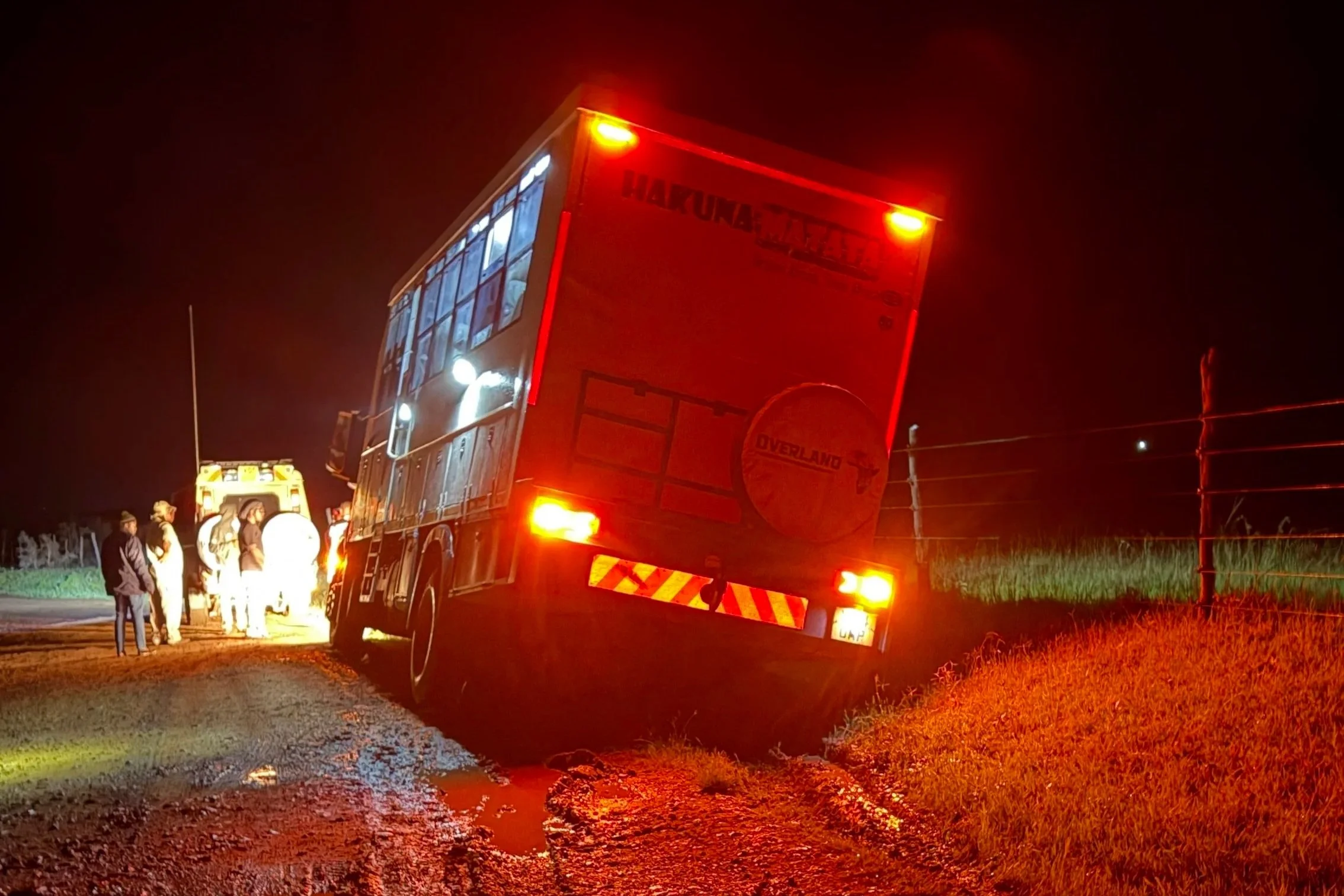
Our truck, stuck in the mud in the middle of a flood in Maasai Mara
There was India, where I climbed onto the back of a motorcycle belonging to a man I had known for approximately 30 second minutes, because sometimes the itinerary is a suggestion and you need to get creative. He asked for my phone number the entire ride, but he got me to the Holi festival. That ride is one of my favorite travel memories ever.
Every one of those moments had a middle I would not have chosen. And every one of them became the story I lead with.
Meanwhile — and this is the part that took me embarrassingly long to admit — I cannot tell you one specific thing that happened at the beach resorts I visited in my old life. Ten years of the same beach. It was nice, but that's the problem. Nice doesn't survive the trip home.
Why your brain does this (and why you should let it)
There's real psychology under the joke. Your brain doesn't file experiences by how pleasant they felt — it files them by how meaningful and how intense they were. Struggle creates contrast, contrast creates memory, and shared struggle creates the fastest, deepest bonds you'll ever form with other humans. It's why the woman who almost cancels twice ends up closest to the group by day two. Nothing welds strangers into your people faster than surviving something slightly ridiculous together.
Discomfort, it turns out, isn't the tax you pay for the good stuff. Discomfort is the good stuff, wearing a disguise.
That's the whole reason I am rebranding my company Type 2 Travel™ (yes — the trademark is officially in process; we're making it ours). Every trip I run is engineered to be exactly the right amount of hard: the growth without the trauma, the story without the actual danger. Type 2 fun, with a vetted local team, a real plan, and someone who's already worried about the parts you'd worry about.
Why your comfort zone is the worst place to be
Here's the thing nobody in the travel industry will say out loud: comfort is a fine place to visit and a terrible place to live.
When everything goes exactly to plan, your brain has nothing to hold onto.
No friction, no memory.
But the night you rolled up to the cheapest hotel in downtown Chicago at some ungodly hour, got greeted by a man in a pirate eye patch and a peg leg (yes, an actual peg leg), who loaded you into a rickety elevator and deposited you in a room boasting an estimated thirty health code violations, a roach infestation, and blood-stained sheets? Your brain recorded that one in 4K. The horror, the laughing, the improvising…and the friend beside you who was equally appalled, — the one you're still telling this story with fifteen years later — because you were both there and nobody else will ever quite get it.
The struggle isn't the price of the memory. It's the ingredient.
That's why the best group-trip friendships form on the worst day of the trip. You can't fast-track the bond that comes from getting rained on together. Believe me, people have tried. It requires actual rain.
And no, I'm not talking about suffering for sport. There's a difference between hard and unsafe, between an adventure and an ordeal, and I've spent five years learning exactly where that line is. I scout every destination before I bring a group (I've written about why). The hotels are vetted. The guides are people I trust with my own mother. The chaos we keep is the good chaos — the kind with a safety net under it, the kind that turns disasters into your best stories.
You bring the yes. Leave the net to us.
Maybe this is you
Maybe you're tired of vacations that photograph well and change nothing.
Maybe you've caught yourself saying "I want to travel more" for the third consecutive year.
Maybe your last vacation was fine — actually fine — and you came home feeling weirdly emptier, like you'd paused your life instead of adding to it.
Maybe you have exactly one wild travel story, you've been retelling it for a decade, and some quiet part of you knows the archive needs new material.
I see you. And I want to offer you a different question to ask about your next trip. Not "will it be relaxing?" Ask this instead: "Will I still be talking about it in five years?"
The beach can't promise you that. The mosquitoes, weirdly, can.
If you're ready for the second kind of trip — the sweaty, occasionally ridiculous, impossible-to-forget kind, with a small group of people who'll be in the story with you — come see where we're going next. Twelve to fourteen people per trip, one departure each, and at least one moment per itinerary that I guarantee will go sideways in the best possible way.
I talked about exactly this with a literal desert-island survival expert on the Type 2 Travel Podcast — why discomfort is the whole point — and he said something I think about constantly: nobody ever grew sitting in a lounge chair.
Because here's what I know for sure: a year from now, somebody's going to be at a dinner table, mid-story, watching everyone lean in. It might as well be you.